
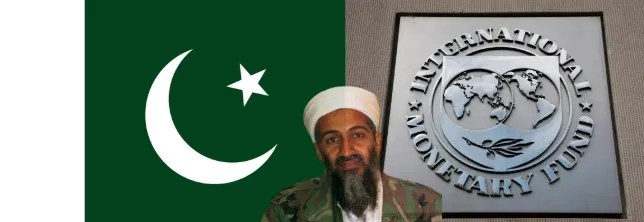
As an Economics and Finance professional, I once admired global institutions, such as the IMF and the World Bank, for their role in fostering global economic stability. However, it is now clear that they serve as intermediaries for Western powers to exert influence, with the United States (16.49% voting share), and G7 nations (>40% voting share) dominating IMF decisions, while countries like India (2.63%) hold significantly less sway. This imbalance enables disproportionate influence, particularly evident in the IMF’s recent $2.4 billion loan to Pakistan ($1 billion disbursed under the $7 billion Extended Fund Facility arrangement approved in September 2024, and an additional $1.4 billion under the Resilience and Sustainability Facility), disbursed in May 2025. Notably, this package included no caveats against terrorist financing.
This recent tranche of loans marks the IMF’s 25th bailout of Pakistan — despite the fact that the country has consistently failed to meet the IMF’s loan spending criteria, and continues to spend disproportionately high amounts on defence and the military. According to the Stockholm International Peace Research Institute (SIPRI), this figure stands at $10 billion — an amount that significantly overshadows its expenditure on health and education. Pakistan’s inclusion on the FATF grey list (2018–2022) for weak anti-money laundering and counter-terrorist financing measures, compounded by its harbouring of Osama Bin Laden, should have raised red flags on this matter.
By disbursing funds without stringent counterterrorism conditions, the IMF risks complicity in Pakistan’s support for terrorist groups. India’s recent Operation Sindoor, which targeted specific Lashkar-e-Taiba and Jaish-e-Mohammed terrorist camps in Pakistan — responsible for major attacks such as Mumbai 2008 — was a response to the recent terrorist attack on Pahalgam in April 2025. Despite India’s repeated requests to Pakistan to cooperate in its investigations — from the 2001 Parliament attacks to Pulwama in 2019 — Pakistan has responded with hollow statements and no meaningful action. Following Operation Sindoor, it became impossible for Pakistan to plausibly deny its role in harbouring terrorism. Hafiz Abdul Rauf, a US-designated terrorist and LeT commander, led funeral prayers for the terrorists killed in the Indian strikes. The funeral, broadcast on Pakistan’s Samaa TV, was attended by Pakistani military and police personnel, with coffins wrapped in Pakistan’s national flag. That is not denial — it is an endorsement of state-sponsored terrorism.
JD Vance’s claim on 8 May 2025 that the United States will not “get involved” in the India–Pakistan conflict is undermined by its extensive influence over the IMF, which continues to shape Pakistan’s financial lifeline. The West must reconsider whether these loans are creating another Frankenstein, as seen with Osama Bin Laden during the Soviet–Afghan War (1979–1989). The CIA’s Operation Cyclone, which channelled extensive economic aid through the Pakistani Inter-Services Intelligence (ISI), empowered the likes of Bin Laden — then part of the Afghan mujahideen — who later formed al-Qaeda, orchestrated 9/11, and inspired attacks such as 7/7 in London. The recent IMF loans risk repeating this error by enabling Pakistan without addressing its sponsorship of home-grown terrorism. As recently as May 2025, several Iranian nationals were arrested in the UK for their involvement in terrorist activities. Is it not clear that Western leaders must leaf through the pages of history and remind themselves how the unchecked flow of financing to known terror states has repeatedly backfired on their own shores?
Finally, one must ask whether the United States continues to strengthen Pakistan not merely to preserve regional influence, but to ensure that India’s rise as a global economic power is curbed. In a world of shifting alliances and global economic competition, the undermining of India may well serve American interests more than is openly acknowledged.

 Beyond News Desk
Leave a comment